
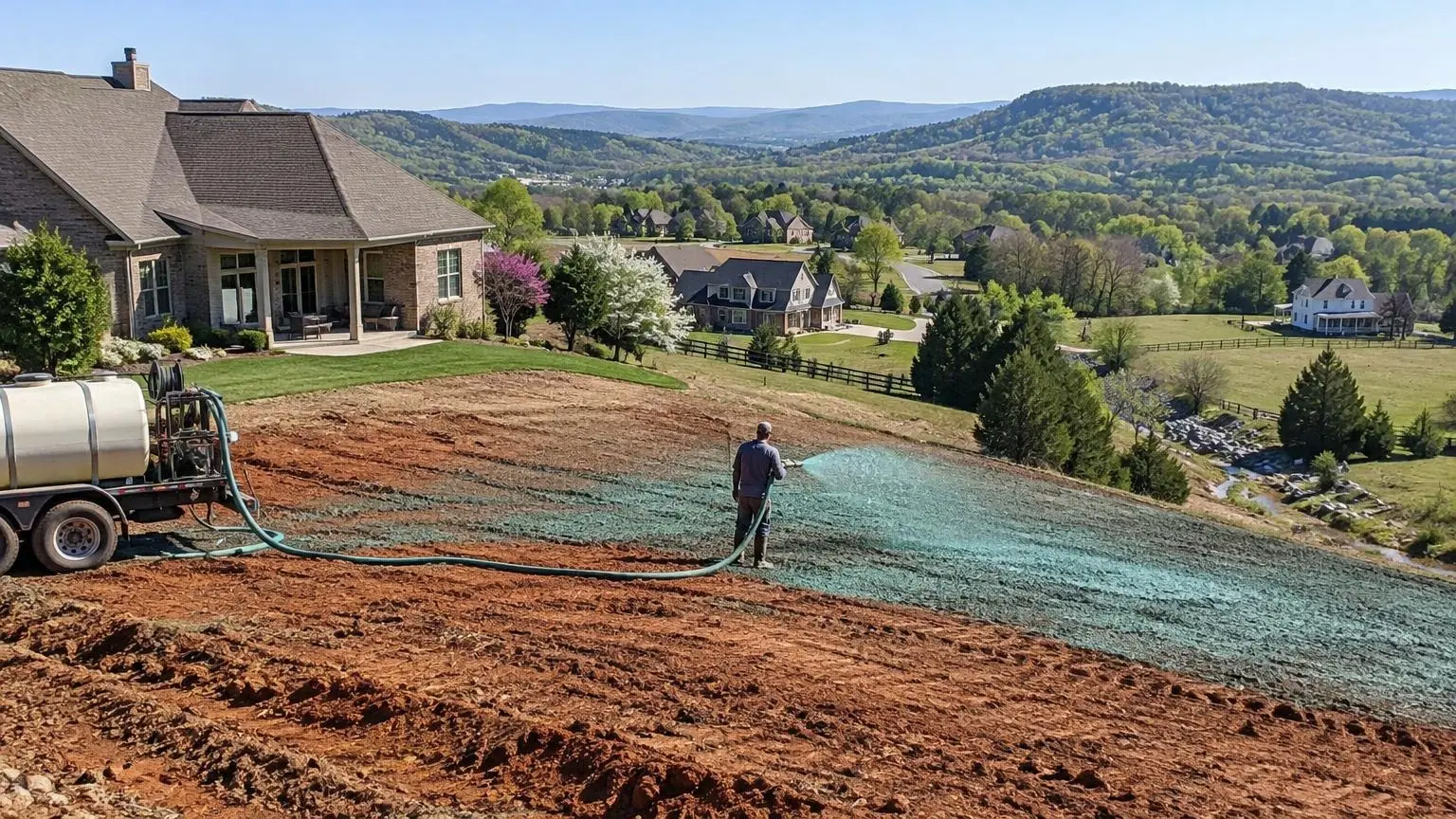
Basin clay, hills and heavy spring rain
Hydroseeding in Nashville, TN
Seed, mulch and erosion control for new lawns, steep yards and job sites across Davidson County and Middle Tennessee.
- Free site visits and written quotes
- Seed mix chosen for the season: fescue in fall, warm-season grass in late spring
- Erosion control and silt fence from the same crew that seeds
Getting Grass to Take on Middle Tennessee Clay
Hydroseeding in Nashville starts with the dirt, and the dirt here is mostly clay. We mix grass seed with fertilizer, tackifier, water and a mulch made from wood or paper fiber, then spray it over bare ground. The mulch holds that seed in place on the hillsides and heavy soils that make Middle Tennessee yards tricky. We handle new lawns for homeowners and builders, hydroseeding for commercial and construction sites, erosion control on slopes and ditches, silt fence and sediment control, grading and topsoil, and lawn repair and overseeding across Davidson County and the surrounding Middle Tennessee towns.
Basin clay and Highland Rim hills
Most of Nashville sits in the northwestern part of the Nashville Basin, and the higher, hillier Highland Rim wraps around it. Inside the city the ground drops to about 385 feet where the Cumberland River runs and climbs to 1,163 feet at Radnor Lake, so a lot of yards are anything but flat. The soils across the Central Basin include the Maury series, which the USDA describes as brown silt loam over reddish brown silty clay and clay. That top layer is often only 5 to 10 inches thick in the official profile, and on a new build it is frequently scraped off, buried or mixed with subsoil. Seed sprayed on raw red clay will sprout, but it struggles to root. So before we price a lawn we check what soil is really on top, and we tell you plainly when topsoil or soil prep will make the difference.
The same USDA description notes that the limestone under these soils is cavernous, with karst in some areas. On a lawn that mostly matters for drainage: water can disappear into the ground in one corner and sit on top of compacted clay in another.
Rain, heat and timing
The 1991 to 2020 normals at Nashville International Airport show about 50.5 inches of precipitation a year. May is the wettest month at just over 5 inches, and October is the driest at about 3.4. Average highs in July and August sit right around 90 degrees, and the region is in USDA Plant Hardiness Zone 7b. Spring and fall storms can bring heavy rain and flash floods, and the May 2010 flood along the Cumberland, the Harpeth and Mill Creek showed how much water these slopes can shed.
For seeding, that climate pushes Nashville into the transition zone, where both cool-season and warm-season grasses are planted. University of Tennessee Extension puts the ideal window for cool-season turf like tall fescue at late August to mid-October, and the window for warm-season grasses like bermudagrass at May 1 to June 30. A fall fescue seeding has cooling nights and the drier autumn months ahead of it. A late-spring bermuda seeding has summer heat to drive it. Seeding fescue in July means watering through the hottest weeks of the year, so we usually advise against it unless the site needs temporary cover.
Sod vs hydroseed vs dry seed
The sod vs hydroseed question comes up on almost every visit. Sod lays down as a finished-looking lawn on day one, but it costs the most per square foot and every roll has to be laid, rolled and watered by hand. HomeGuide's range for installed sod runs from $1 to $4 a square foot. Dry broadcast seed is the cheapest, but on a Nashville slope the first hard rain can move it to the bottom of the yard. Hydroseeding sits in between: the mulch layer keeps seed in contact with soil, holds moisture, and makes it visible so you can see exactly where it landed. University of Nebraska Extension sums it up simply: hydro seeding costs a little more than dry seeding and generally less than sodding.
Hydroseed lawn installation also lets us change the mix for each part of the property. A shady side yard under oaks gets a different blend than a sunny front slope, and a steep bank can get extra mulch and tackifier. The tradeoff is time. Grass usually shows in 5 to 7 days under good conditions, the first mow comes around four to six weeks out, and the lawn needs steady watering until it is established.
Stormwater and grading rules in Davidson County
Metro Water Services handles stormwater for most of Davidson County, and its Stormwater Division issues grading permits for land disturbance. Small landscaping jobs on existing lots are exempt when they stay under 10,000 square feet of disturbed area, change grade no more than 18 inches, move no more than 100 cubic yards of material, and get temporary or permanent stabilization on bare ground within 15 days. Even exempt work is still expected to follow Metro's erosion and sediment control guidelines. Larger projects go through plan review and a pre-construction meeting before work begins.
For most homeowners the takeaway is simple: do not leave bare dirt sitting. Seeding or mulching within about two weeks of grading keeps you inside the rules and keeps your soil in your yard instead of the storm drain. Fill in a mapped floodplain has its own rules; Metro requires fill placed in the floodplain to be offset with an equal volume of cut. We will tell you on the site visit if anything about your lot points toward a permit.
What a typical job looks like
- Walk the site. We check slope, drainage paths, sun and shade, what the soil looks like, and where runoff leaves the property.
- Fix the ground first. Rocks, roots and construction debris come out. Low spots get filled, high spots cut, and the grade slopes away from the house.
- Add topsoil where it is missing. Bare subsoil gets a layer of topsoil or a soil amendment so roots have somewhere to go.
- Protect the edges. On sites that drain toward a street, creek or inlet, silt fence or other sediment control goes in before the soil is opened up.
- Spray. The slurry goes down in one pass or two, heavier on slopes. Erosion control blankets go on the steepest banks and in swales.
- Hand off. You get written watering, mowing and fertilizing instructions and a call if the weather turns.
Who we work for
Homeowners with a new house and a bare yard, a lawn that never filled in, or a slope that keeps washing. Builders who need lots stabilized and green before closing. Commercial and site contractors who need temporary seed on stockpiles and disturbed areas or permanent seed on finished slopes and detention areas. If you are comparing hydroseeding companies around Nashville, ask each one how they plan to deal with the clay, the slope and the season. Those three things decide whether a new lawn takes.
Common Questions
What does hydroseeding a 3,000 sq ft Nashville yard cost?
For residential hydroseeding, HomeGuide's national figures run from $0.12 up to $0.35 a square foot. Its examples are about $500 to $700 at 2,000 square feet and $1,000 to $1,750 at 5,000 square feet, and a 3,000 square foot yard lands between them. Many companies also have a minimum job fee, which LawnStarter puts at $300 to $500. Slope, soil prep and access shift the total, and the number we put in writing for your yard is the one you are billed.
What USDA plant hardiness zone is Nashville, Tennessee in?
The Nashville region is in USDA Plant Hardiness Zone 7b. For lawns, the more useful fact is that Nashville sits in the transition zone, where tall fescue and warm-season grasses like bermudagrass both grow, each with its own planting window.
What part of the year suits hydroseeding a Nashville yard?
For tall fescue and other cool-season grasses, University of Tennessee Extension recommends late August to mid-October. For warm-season grasses like bermudagrass, it recommends May 1 through June 30. Construction sites that need temporary cover can be seeded through more of the year with a suitable mix.
Is hydroseeding better than sod in Nashville?
It depends on budget and timing. Sod is instant but costs much more per square foot, while hydroseed costs less and gives you a choice of seed mix, but takes several weeks to fill in. On slopes and larger yards, hydroseed is usually the more practical choice.
Will hydroseed wash away in a heavy rain?
The fiber mulch and tackifier hold seed far better than dry seed, but a hard storm on freshly sprayed bare clay can still cut rills. On steep slopes and in swales we add heavier mulch or erosion control blankets, and we watch the forecast when scheduling.
Do I need a permit to regrade and seed my yard in Davidson County?
Usually not for a typical yard. Metro Water Services exempts landscaping on existing lots if the disturbed area stays under 10,000 square feet, grade changes stay under 18 inches, material stays under 100 cubic yards, and the bare soil is stabilized within 15 days. Floodplain lots and bigger projects are different, and we will flag those on the visit.
How long until I can mow a hydroseeded lawn?
Under good conditions you should see sprouts within 5 to 7 days. Plan on the first mowing roughly four to six weeks after the seed goes down, when the grass reaches about 4 inches. Keep people and pets off the lawn until then.
How often should I water new hydroseed?
Keep the mulch layer damp, not soaked. In warm weather plan on two or three light waterings each day during the first few weeks. Once roots take hold, water less often but more deeply.
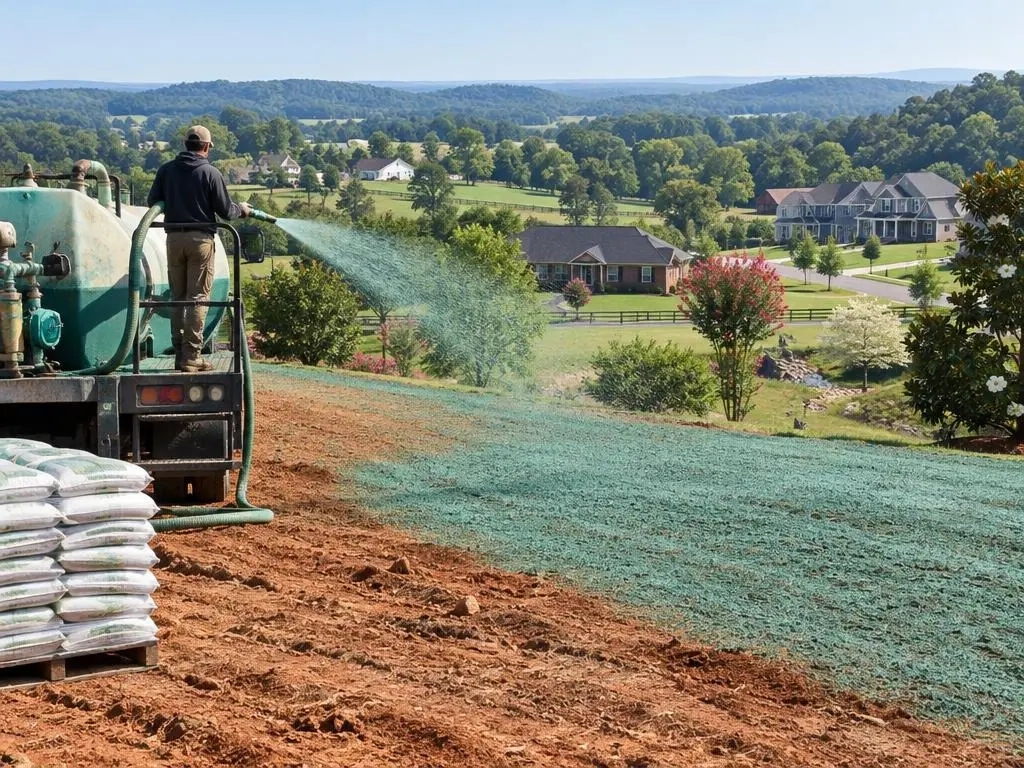
Our Services
Six kinds of work, from a single bare front yard to acres of graded construction ground.
New Lawn Hydroseeding
A full new lawn sprayed in seed, mulch and fertilizer, timed for fescue or bermuda season.
Learn more →Builder & Commercial Hydroseeding
Hydroseed for subdivision lots, commercial pads, detention areas and disturbed construction ground.
Learn more →Slope & Erosion Control
Hydromulch, bonded fiber matrix and erosion control blankets to hold eroding Nashville banks, ditches and swales.
Learn more →Silt Fence & Sediment Control
Silt fence installation, inlet protection and sediment barriers for building lots and construction sites.
Learn more →Grading, Topsoil & Dirt Work
Yard grading, land grading, topsoil and the dirt work that has to be right before seed goes down.
Learn more →Lawn Repair & Overseeding
Patching bare spots, renovating thin fescue and overseeding tired lawns at the right time of year.
Learn more →Towns We Seed Around Nashville
We work throughout Nashville and Davidson County and out into the surrounding counties. South of the city, Brentwood, Franklin, Nolensville, Thompson's Station, Spring Hill and Columbia mix large estate lots with fast-growing subdivisions, and much of that ground drains to the Harpeth or the Duck River. To the southeast, Murfreesboro, Smyrna and La Vergne sit on flatter basin ground where drainage, not slope, is usually the problem. East toward Mount Juliet and Lebanon the soil can be thin over limestone, with cedar glades and karst. North of the Cumberland, Goodlettsville, Hendersonville, Gallatin, White House, Springfield, Portland and Pleasant View run from lakeside slopes to old farm fields turning into neighborhoods. West of town, Ashland City, Kingston Springs, Fairview and Dickson climb onto the hillier Highland Rim. The individual town pages spell out what we check for in each place.
- Hydroseeding in Nashville, TN
- Hydroseeding in Franklin, TN
- Hydroseeding in Brentwood, TN
- Hydroseeding in Murfreesboro, TN
- Hydroseeding in Smyrna, TN
- Hydroseeding in La Vergne, TN
- Hydroseeding in Hendersonville, TN
- Hydroseeding in Gallatin, TN
- Hydroseeding in Mount Juliet, TN
- Hydroseeding in Lebanon, TN
- Hydroseeding in Spring Hill, TN
- Hydroseeding in Nolensville, TN
- Hydroseeding in Thompson's Station, TN
- Hydroseeding in Goodlettsville, TN
- Hydroseeding in White House, TN
- Hydroseeding in Springfield, TN
- Hydroseeding in Columbia, TN
- Hydroseeding in Fairview, TN
- Hydroseeding in Dickson, TN
- Hydroseeding in Portland, TN
- Hydroseeding in Ashland City, TN
- Hydroseeding in Pleasant View, TN
- Hydroseeding in Kingston Springs, TN
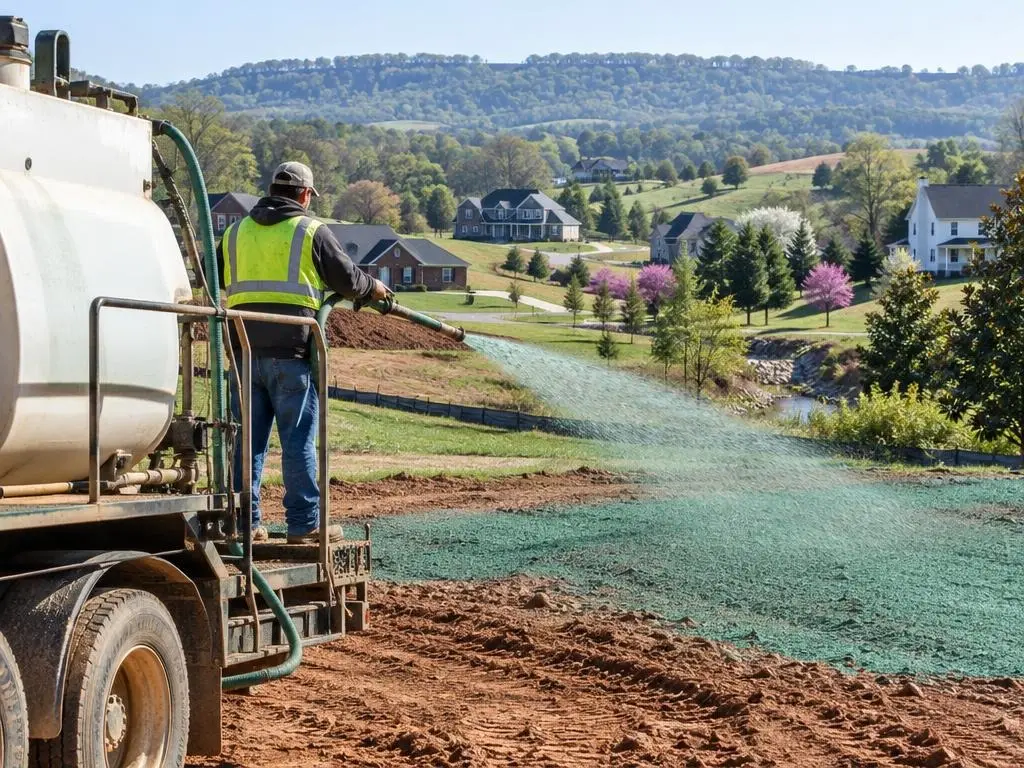
Why Homeowners Call Hydroseeding Nashville
Seeding by the calendar
We plan cool-season fescue for late summer and fall and warm-season grass for May and June, and we tell you when waiting will give you a better lawn.
Soil before seed
If your yard is bare red clay or builder fill, we say so in the quote and price topsoil or prep as its own line.
Slope-ready
Heavier mulch, tackifier and erosion control blankets on steep banks and swales, sized to how the water actually runs.
One crew, whole job
Grading, silt fence, seed and blankets from the same company, so nothing waits on another contractor.
Ready to Seed That Bare Yard?
Free site visits across Nashville and Middle Tennessee. Call (615) 437-2205 or send the form.